
CIBSE TM59 Overheating Assessments
Standardised Overheating Risk Compliance Reports for Residential Developments
What is a CIBSE TM59 Assessment?
Published by the Chartered Institution of Building Services Engineers, CIBSE TM59 provides a standardised design methodology for assessing overheating risks in homes. Before its introduction, the industry lacked uniform criteria for overheating assessments, leading consultants to use varying models with no consistent baseline.
Today, TM59 serves as the definitive UK benchmark. It is widely mandated by local planning authorities, building control bodies, and framework standards like Building Regulations Part O to ensure new homes remain safe, comfortable, and legally compliant.
Why Overheating Risk Has Increased
Changing weather patterns in the UK mean we are experiencing more extreme climate events, including significantly hotter summer periods. Alongside climate shifts, modern architectural trends and building standards have evolved:
Higher Insulation Levels: Properties constructed prior to the 1980s rarely featured insulation. Today's strict building fabric standards mean modern properties are highly efficient at trapping heat.
Increased Airtightness: Modern construction methods result in dramatically lower air permeability rates, reducing natural draft cooling.
Glazed Facades: Architectural designs often favour expansive glazing, which introduces high solar heat gains.
While trapping heat is critical for reducing winter energy consumption, retaining that thermal energy during the summer months introduces a major risk of building overheating.
Our CIBSE TM59 Methodology & Standards
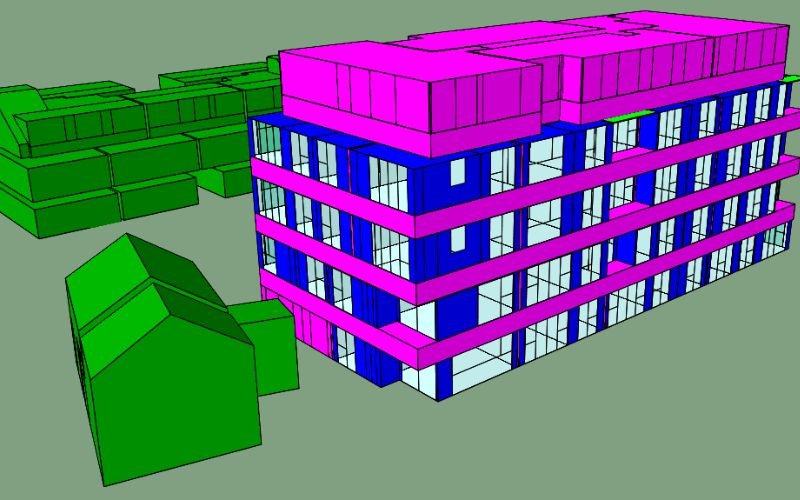
The TM59 framework utilises advanced, dynamic 3D thermal modelling software to simulate real-world conditions. The methodology relies on precise, standardised data sets to ensure modelling accuracy, including:
Occupancy Profiles: Standardised hours of occupancy for daytime living areas and nighttime bedrooms.
Internal Heat Gains: Standardised profiles calculating latent heat emissions from cooking appliances, electrical equipment, lighting, and occupants.
Ventilation Controls: Prescriptive rules dictating the precise internal temperatures at which occupants are assumed to open windows.
Communal Heat Gains: Accounted heat losses from community heating schemes or hot water pipework running through unventilated communal corridors.
To achieve TM59 compliance, the 3D simulation must demonstrate that internal temperatures will not exceed comfortable living thresholds for a set number of hours throughout a simulated calendar year. Separate, strict comfort criteria apply to both daytime hours and nighttime sleeping conditions.
Get Expert Assistance
Up Energy has been producing comprehensive CIBSE TM59 overheating reports since the framework’s inception. Utilising advanced dynamic simulation software, we collaborate closely with design teams to guide glazing layouts, shading strategies, and ventilation configurations.
We service residential projects of all scales — from bespoke self-build single dwellings to multi-storey apartment blocks across Exeter, Devon, and the South West.
What We Do
-
![Icon representing Energy Performance Certificate services]()
EPC
Required when a building is constructed, sold or let. Covering Devon, Cornwall, Somerset and beyond.
-
![Icon representing SAP Calculations]()
SAP Calculations
New build and conversion energy calculations for residential properties.
-
![Icon representing SBEM Calculations]()
SBEM Calculations
Commercial new build and conversion energy calculations.
-
![Icon representing Part O Overheating compliance]()
Part O — Overheating
Dynamic thermal modelling for residential overheating compliance.
-
![Icon representing Thermal Modelling]()
Thermal Modelling
Advanced building energy modelling including BREEAM, TM52, TM59 and ventilation.
-
![Icon representing ESOS compliance]()
ESOS
Lead Energy Assessor qualified audits for ESOS compliance.






Read our Google customer reviews

-
![Five star graphic from customer Google review of Up Energy Ltd.]()
"Up Energy offers a highly professional service, quickly, discretely and with good communication. Highly recommended."
Keith Thompson – Energy assessment
-
![Five star graphic from customer Google review of Up Energy Ltd.]()
"I have worked with Up Energy on several projects now and they have always delivered on time while being easy to work with. Their pro-active approach makes the production of energy calculations and final certification at the end of a project a simple process."
Tim Thompson – Repeat client, energy calculations and certification
-
![Five gold stars, indicating a five-star rating]()
"We had to obtain 39 EPC certificates for a student building and Up Energy carried out the whole certification process for us, efficiently and quickly and always keeping us well informed."
Jeffrey Seed – Student accommodation, Exeter