
Display Energy Certificates (DEC)
Accredited Operational Ratings and Advisory Reports for Public and Institutional Buildings
What is a Display Energy Certificate?
A Display Energy Certificate (DEC) evaluates a building's energy efficiency based on its actual operational energy consumption. Unlike an EPC, which models a property’s theoretical asset rating, a DEC reflects real-world utility usage.
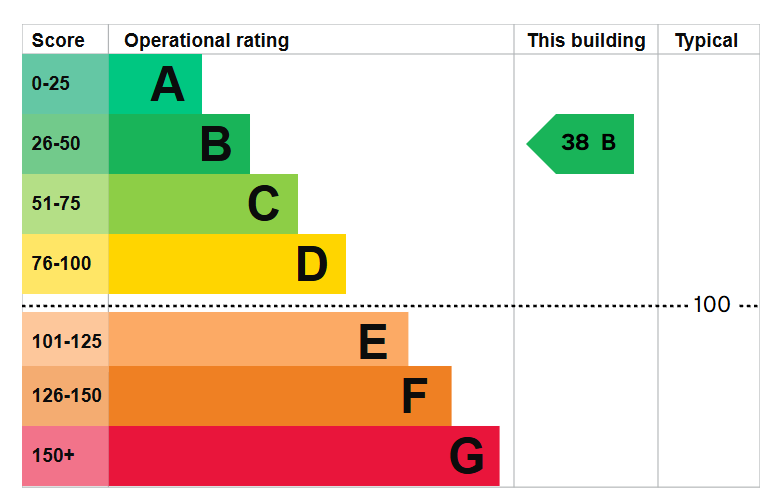
The resulting certificate displays an operational rating on an A to G scale. When an organizsation maintains regular annual assessments, the DEC visually tracks year-on-year historical trends on the certificate, providing a powerful metric to demonstrate carbon reduction and energy savings over time.
Is Your Building Legally Required to Display a DEC?
Under UK legislation, non-domestic buildings must legally obtain and prominently display a valid DEC and an accompanying Advisory Report (AR) if they meet the following criteria:
Occupied in whole or part by public authorities, statutory institutions, or publicly funded organisations.
Frequently visited by members of the public.
Maintain a total useful floor area greater than 250m².
Up Energy provides comprehensive public sector assessments for an array of institutional assets throughout the South West, including:
NHS hospitals, clinics, and local GP surgeries
Primary schools, secondary academies, and university campuses
Local authority leisure centres, libraries, and civic offices
Private Sector DECs: While mandatory for the public sector, forward-thinking private businesses frequently commission voluntary DECs. It serves as an objective, year-on-year benchmark to anchor internal corporate sustainability targets and ESG reporting.
Information Required for a DEC Assessment
Display Energy Certificates can only be calculated, validated, and legally lodged by a fully accredited DEC Assessor. To compile the operational rating and the mandatory Advisory Report, our assessment team requires:
12 Months of Energy Data: Uninterrupted records of actual electricity, gas, oil, or biomass consumption spanning a continuous 12-month period.
Building Asset Data: Architectural footprints, building envelope specifications, and records of any on-site renewable generation (such as solar PV arrays). If the building holds an existing asset EPC, this can be integrated into the framework.
Site Inspection & Operations Audit: A brief site walkthrough evaluating HVAC infrastructure, active ventilation controls, and building management systems. This includes a brief consultation regarding operational schedules and equipment maintenance cycles.
Frequently Asked Questions
-
Display Energy Certificate.
-
As from 9th July 2015 buildings over 250 m2 that are occupied by public authorities and frequently visited by the public. Some of these can include schools, hospitals, doctors surgeries, council offices. Up Energy can undertake Display Energy Certificates on all buildings, including the new lower 250 m2 threshold.
-
For buildings over 1000 m2 the DEC is valid for 12 months and should be renewed every year For these buildings an Advisory report is valid for 7 years. For buildings between 250 m2 and 999 m2 the DEC and advisory report are valid for 10 years. Although, many organisations choose to renew their <1000 m2 DEC every 12 months so that they can track their year on year energy usage.
-
A DEC is designed to be displayed in a prominent place in the building and shows the energy rating of that building over the last 12 months using actual energy consumption. This is called the operational rating and is a numerical indicator in graph form of the carbon emissions of that building compared to other building of that type.
-
The DEC scale goes from A to G, A being better.
-
The advisory report accompanies a DEC and contains a range of improvement and cost effective measures that can help improve the energy performance of the building. Most public buildings over 1000 m2 would have had their first DEC and Advisory Report produce when the legislation was first introduced in 2008. As an Advisory Report is valid for 7 years this is an ideal time to instruct a DEC assessor from Up Energy to visit the site and renew the Advisory Report and DEC. We can also undertake Display Energy Certificates and Advisory Reports falling into the new 250 – 999 m2 threshold.
-
A qualified DEC assessor must visit the property to collect data regarding heating, hot water, lighting, building fabric and room activities. Ideally scale plans should be provided to the assessor for this purpose. A full 12 months of accurate energy bills will also need to be provided.
-
It depends on the size and complexity of the building. Once a DEC and advisory report have been undertaken the follow up years DEC can often be undertaken without the assessor going back to site which can significantly reduce the cost thereafter. Contact Up Energy for a no obligation quote and advice. Now is a great time to renew your DEC and Advisory Report if your building was over 1000 m2, Up Energy can also undertake Display Energy Certificates on the smaller 250 m2 buildings at the same time, reducing site visits and costs to you.
Read our Google customer reviews

-
![Five gold stars, indicating a five-star rating]()
"We had to obtain 39 EPC certificates for a student building and Up Energy carried out the whole certification process for us, efficiently and quickly and always keeping us well informed."
Jeffrey Seed – Student accommodation, Exeter
-
![Five star graphic from customer Google review of Up Energy Ltd.]()
"I have worked with Up Energy on several projects now and they have always delivered on time while being easy to work with. Their pro-active approach makes the production of energy calculations and final certification at the end of a project a simple process."
Tim Thompson – Repeat client, energy calculations and certification
-
![Five star graphic from customer Google review of Up Energy Ltd.]()
"Having initially been quoted and let down by a national company I was concerned the deal would fall through. However Simon very quickly sorted everything out and surveyed that morning. Cannot recommend enough."
Emma Ranson Bellamy – Commercial EPC, urgent lease instruction

Explore Our Specific Services
-
![Icon representing Energy Performance Certificate services]()
EPC
Required when a building is constructed, sold or let. Covering Devon, Cornwall, Somerset and beyond.
-
![Icon representing SAP Calculations]()
SAP Calculations
New build and conversion energy calculations for residential properties.
-
![Icon representing SBEM Calculations]()
SBEM Calculations
Commercial new build and conversion energy calculations.
-
![Icon representing Part O Overheating compliance]()
Part O — Overheating
Dynamic thermal modelling for residential overheating compliance.
-
![Icon representing Thermal Modelling]()
Thermal Modelling
Advanced building energy modelling including BREEAM, TM52, TM59 and ventilation.
-
![Icon representing ESOS compliance]()
ESOS
Lead Energy Assessor qualified audits for ESOS compliance.






Request a Quote
For more information on our services please call, email or send an enquiry through the contact form.
Contact us
07515 442665 (Simon)
07974 567272 (Alistair)

Please read our Privacy Policy and Terms and Conditions before submitting.